Applications for the KAIST Scholarship 2027 are open now for international students. KAIST is one of the best universities in Asia. It is also one of the most generous when it comes to funding international students.
Almost every student who gets admitted to KAIST receives a scholarship. This is not a small merit award. It is a full package that covers tuition and living costs. Many students describe KAIST as one of the few universities where you can complete a world-class degree without going into debt.
This page covers everything you need to know about the KAIST Scholarship. It covers undergraduate and graduate programs, eligibility and benefits, deadlines and documents each and everything.
At a Glance – KAIST Scholarship 2027
| Detail | Information |
|---|---|
| University | Korea Advanced Institute of Science and Technology |
| Location | Daejeon, South Korea |
| Scholarship | Available for undergraduate and graduate students |
| Tuition Coverage | Full tuition waiver for most admitted students |
| Monthly Stipend | Available for graduate students |
| Language of Instruction | English |
| IELTS Required | Not required for most programs |
| Eligible Applicants | International students worldwide |
| Application System | KAIST Online Admission Portal |
| Official Website | kaist.ac.kr |
What Is KAIST
KAIST stands for Korea Advanced Institute of Science and Technology. It was founded in 1971. The South Korean government created it to develop science and technology talent for the country.
Today KAIST is ranked among the top universities in the world. It is especially strong in engineering, science, computer science, and technology. Many of the best researchers in Asia have studied or worked at KAIST.
Classes at KAIST are taught in English. This makes it accessible for international students who do not speak Korean. You do not need to know Korean to study at KAIST. But learning basic Korean will make daily life easier.
KAIST has four campuses. The main campus is in Daejeon. There are also campuses in Seoul and other cities. Most undergraduate and graduate students study at the Daejeon campus.
Why Students Choose KAIST
There are many good universities in Asia. So why do students specifically target KAIST?
A few reasons stand out.
The scholarship coverage is exceptional. Almost every admitted international student receives tuition support. Graduate students also receive a monthly living stipend. Very few universities offer this level of automatic financial support.
The academic environment is intense but rewarding. KAIST focuses almost entirely on science, technology, engineering, and mathematics. If that is your field, the resources and research opportunities are hard to match anywhere in Asia.
KAIST also has strong connections to Korean industry. Samsung, LG, Hyundai and many major technology companies recruit directly from KAIST. For students interested in careers in Korea or the Asian technology sector, these connections matter.
KAIST Scholarship for Undergraduate Students
KAIST admits a limited number of international undergraduate students each year. The competition is strong. But the financial support is excellent.
What the undergraduate scholarship covers:
- Full tuition waiver for the entire degree
- A monthly living allowance to cover basic living costs
- Dormitory support (subject to availability)
The undergraduate program at KAIST takes four years to complete. Students choose from programs across science, engineering, computer science, business, and humanities.
One important thing to know: undergraduate admission at KAIST is highly competitive for international students. KAIST admits only a small international undergraduate cohort each year. Meeting the minimum requirements is not enough. Strong applicants demonstrate excellent academic records, solid science and math skills, and clear motivation for studying at KAIST specifically.
For a complete guide to the undergraduate application process and requirements, visit the dedicated undergraduate guide on this website.
→ Apply Now for KAIST Undergraduate Scholarship
KAIST Scholarship for Graduate Students
Graduate study is where KAIST’s scholarship program is most generous.
Most international students who are admitted to a Master’s or PhD program at KAIST receive a full scholarship automatically. This includes tuition coverage and a monthly stipend paid directly to the student.
What the graduate scholarship typically covers:
- Full tuition waiver each semester
- Monthly stipend (amount varies by program and research funding)
- Health insurance support
- Dormitory accommodation (subject to availability)
→ Apply Now for KAIST Graduate Scholarship
The monthly stipend for graduate students comes from two sources. KAIST provides a base stipend through its institutional scholarship. Research advisors often supplement this with additional funding from their research grants. The combined amount varies depending on your department and advisor.
Graduate students at KAIST are expected to participate in research activity. This is not optional. It is part of how the scholarship system works. Your research advisor plays a central role in your academic experience and in the additional funding you receive.
Choosing the right research advisor before you apply is one of the most important decisions you will make in the KAIST application process. So check our guide on How to Email KAIST Professors
Eligibility — Who Can Apply
KAIST welcomes applications from international students around the world. The basic eligibility requirements are the same for most programs.
For undergraduate applicants:
- Completion of high school education (or expected completion before enrollment)
- Strong academic performance in science and mathematics subjects
- Proof of English proficiency (KAIST accepts various forms of evidence)
- Meeting any program-specific requirements listed in the current admission notice
For graduate applicants:
- A completed bachelor’s degree for Master’s applicants
- A completed Master’s degree for PhD applicants (some programs admit students directly from bachelor’s to PhD)
- Academic background relevant to the chosen program
- A confirmed or prospective research advisor in most cases
- Proof of English proficiency
On age and nationality: KAIST does not restrict applications by age or nationality. Students from any country can apply. However, some specific scholarship tracks have nationality-based conditions. Always check the current admission notice for the program you are targeting.
On career breaks and non-traditional backgrounds: Graduate programs at KAIST consider applicants with work experience between degrees. A gap between your bachelor’s and master’s degree is not automatically a disadvantage.
English Proficiency — Do You Need IELTS
This is one of the most common questions students ask.
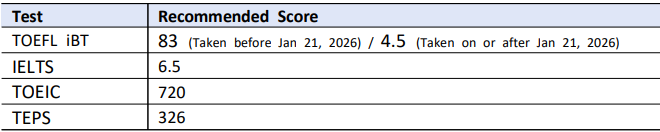
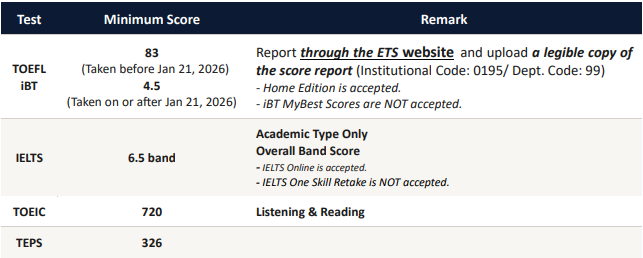
KAIST does not require IELTS for most programs. It accepts a range of English proficiency evidence including TOEFL, TOEIC, and in some cases a medium of instruction letter from your previous university confirming your degree was taught in English.
Requirements vary slightly by program and admission cycle. Check the specific requirements for your target program in the current official admission notice.
For students who completed their undergraduate degree entirely in English this is usually straightforward. A medium of instruction letter from your university is often sufficient.
→ Check Complete Guide KAIST English Proficiency Requirements
Available Programs and Majors
KAIST offers programs across a wide range of science and technology fields.
Undergraduate programs include:
- School of Freshmen (students choose their major after the first year)
- College of Natural Sciences
- College of Engineering
- School of Computing
- College of Business
- Graduate School of Culture Technology
Graduate programs cover:
- Electrical Engineering
- Mechanical Engineering
- Computer Science and Engineering
- Chemical and Biomolecular Engineering
- Materials Science and Engineering
- Civil and Environmental Engineering
- Industrial and Systems Engineering
- Mathematics
- Physics
- Chemistry
- Biological Sciences
- Brain and Cognitive Sciences
- Business and Technology Management
- Culture Technology
- And many interdisciplinary programs
KAIST regularly updates its program offerings. Visit the official KAIST admissions page for the current complete list of available programs.
Tuition Fees at KAIST
This section answers one of the most searched questions about KAIST.
KAIST tuition fees exist. But most admitted international students do not pay them because the scholarship covers tuition in full.
What tuition looks like without a scholarship:
KAIST charges tuition each semester. The amount varies by program level and year. Graduate programs have different fee structures from undergraduate programs. Exact figures change each academic year.
For current tuition figures visit the official KAIST fee information page.
What most admitted students actually pay:
For undergraduate international students receiving the KAIST scholarship the tuition waiver covers all semester tuition fees.
For graduate students the institutional scholarship waives tuition. Depending on research funding additional support may be available from your advisor’s research budget.
The practical answer for most admitted students is: tuition cost is zero. The monthly stipend covers living expenses. But this is conditional on maintaining satisfactory academic and research progress.
Monthly Stipend for KAIST Students
Graduate students at KAIST receive a monthly stipend. The amount is not fixed across all programs and students.
The stipend comes from two sources.
The first source is KAIST’s institutional scholarship. This provides a base monthly amount to scholarship recipients.
The second source is the research laboratory. Most graduate students work in a research lab under a faculty advisor. That advisor often provides additional monthly support from research grant funding. The combined stipend is therefore partly dependent on which lab you join and how well-funded that lab is.
Stipend amounts change and vary. Publishing a specific figure here would likely become outdated quickly. Check the current official KAIST scholarship documentation for the most recent figures.
What students consistently report is that the combined stipend covers basic living costs in Daejeon comfortably. Daejeon is not an expensive city by international standards. Most students find the stipend sufficient for rent, food, and basic expenses.
KAIST Scholarship Application Process 2027
The KAIST application process is fully online. It is managed through the KAIST online admission portal.
Step 1: Choose your program Decide whether you are applying for undergraduate or graduate study. Identify the specific department or school you want to apply to.
Step 2: Contact a potential advisor (graduate applicants) For graduate programs, identifying a research advisor before applying is strongly recommended. Many departments expect applicants to have had initial contact with a faculty member before submission.
Step 3: Prepare your documents Gather all required documents early. Do not leave document preparation to the final week before the deadline.
Step 4: Complete the online application Fill out the application form on the official KAIST admission portal. Upload all required documents.
Step 5: Pay the application fee KAIST charges an application fee. The amount is listed on the official admissions page. Keep your payment confirmation.
Step 6: Submit and wait After submission KAIST reviews applications and notifies applicants of decisions according to the timeline published in the admission notice.
Required Documents
Documents required vary slightly between undergraduate and graduate programs. The following list covers the standard requirements for most applicants.
For undergraduate applicants:
- Completed online application form
- High school transcripts (official)
- High school diploma or proof of expected graduation
- English proficiency test score or equivalent evidence
- Personal statement or study plan
- Letters of recommendation
- Valid passport copy
- Recent passport-size photograph
- Any additional documents listed in the current admission notice
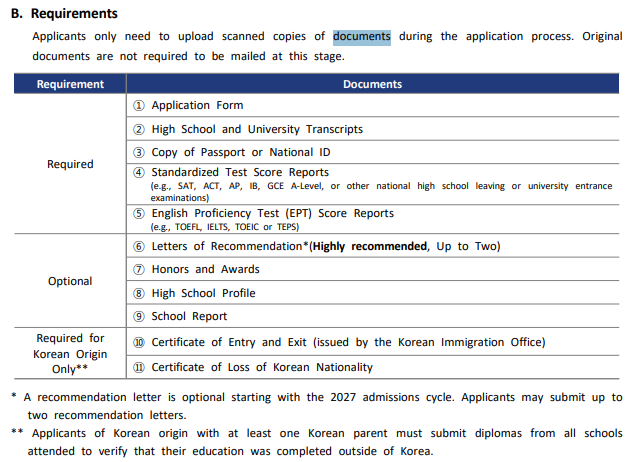
For graduate applicants:
- Completed online application form
- Official transcripts from all previous universities
- Bachelor’s degree certificate (and master’s for PhD applicants)
- English proficiency test score or equivalent evidence
- Statement of purpose
- Research proposal (for PhD applicants in most programs)
- Letters of recommendation (usually two to three)
- CV or resume
- Valid passport copy
- Recent passport-size photograph
- Publications list if applicable
- Any additional documents specified by the department
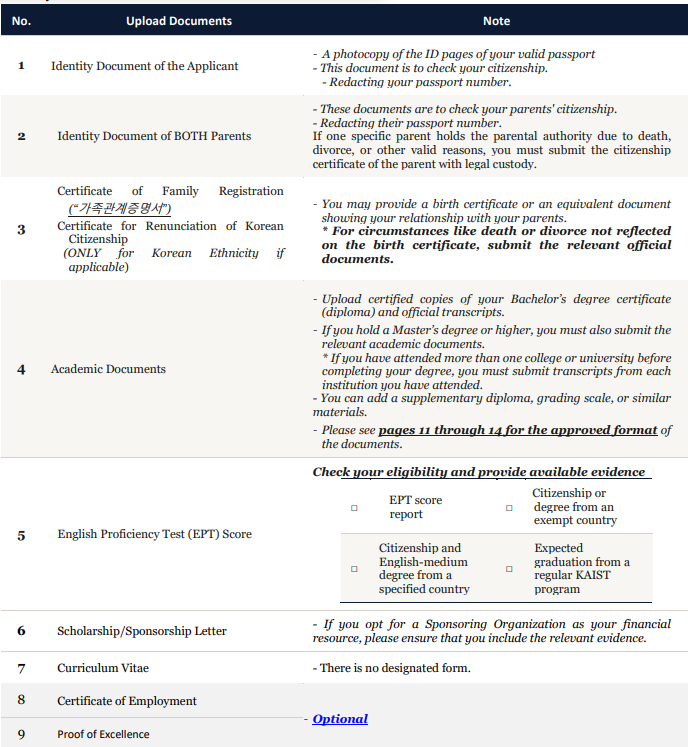
All foreign documents must usually be accompanied by official translations into English or Korean. Check the specific requirements in the admission notice for the current cycle.
Application Deadlines
KAIST runs admission cycles twice per year in most cases. There is typically a spring intake and a fall intake.
Exact deadlines change each cycle. The most reliable source for current deadlines is always the official KAIST admissions portal.
General pattern based on historical cycles:
- Spring semester intake applications typically close in the second half of the previous year
- Fall semester intake applications typically close in the first few months of the same year
For the 2027 academic year applicants should monitor the official KAIST admissions page from the second half of 2026 onward.
Do not rely on deadline information from previous years. KAIST adjusts its cycle dates regularly. Missing a deadline because of outdated information is avoidable.
How KAIST Selects Students
KAIST does not make admission decisions based on grades alone.
For undergraduate students the selection process typically includes document review and may include an interview. Academic performance in science and mathematics subjects is important. But KAIST also looks for evidence of research curiosity, clear motivation, and potential to contribute to the KAIST academic community.
For graduate students the research fit is central. This means the alignment between your academic background, your proposed research direction, and the interests of the faculty advisor you want to work with. A strong statement of purpose that clearly articulates your research goals and connects them to the specific faculty member’s work carries significant weight.
KAIST admission is competitive. But it rewards clarity and focus over generic applications. Students who know what they want to study and can explain why KAIST specifically is the right environment for that work are in a stronger position than students with higher grades but vague applications.
Scholarship Tracks at KAIST
KAIST offers several scholarship programs. The main ones for international students are listed below.
KAIST Scholarship (main institutional scholarship): This is the primary scholarship for admitted graduate international students. It covers tuition and provides a base monthly stipend.
Global Korea Scholarship (GKS): This is a South Korean government scholarship program. It is managed separately from KAIST’s own institutional scholarship. GKS scholars receive additional benefits including Korean language training before their degree begins.
KAIST Graduate School Programs: Certain graduate schools and departments at KAIST have their own scholarship arrangements tied to specific research programs or international partnerships.
Korean Origin Applicants: KAIST has a separate scholarship track for students of Korean heritage. If this applies to you, check the specific requirements for that track.
→ KAIST Scholarship for Korean Origin Applicants
Frequently Asked Questions
Is KAIST fully funded for international students?
Most admitted international graduate students receive a full tuition waiver and a monthly stipend through KAIST’s institutional scholarship. Undergraduate international students also receive tuition support. The exact coverage depends on the scholarship track and program.
Does KAIST require IELTS?
KAIST does not require IELTS specifically. It accepts TOEFL, TOEIC, and in some cases a medium of instruction letter. Requirements vary by program. Check the current admission notice for your target program.
Can I apply to KAIST without contacting a professor?
For undergraduate programs this is not required. For most graduate programs it is strongly recommended and in some departments it is expected. Contacting a professor in advance improves your chances significantly.
How competitive is KAIST admission?
Very competitive. KAIST receives a large number of international applications for a limited number of places. Academic excellence is necessary but not sufficient. Research fit, clarity of purpose, and advisor interest all matter.
Is Korean language required for KAIST?
Classes are taught in English. Korean language ability is not required for admission or academic study. But learning basic Korean will make daily life in Daejeon considerably easier.
When does KAIST accept applications?
KAIST has two main intake cycles per year. Exact dates change each cycle. Monitor the official KAIST admissions page from mid-2026 onward for 2027 intake deadlines.
Can final-year students apply for KAIST?
Yes. Students who are completing their qualifying degree can apply conditionally. The completion deadline varies by cycle. Check the current admission notice for the exact requirement.